
September 30, 2025
by Althea Nicole N. Leoncito
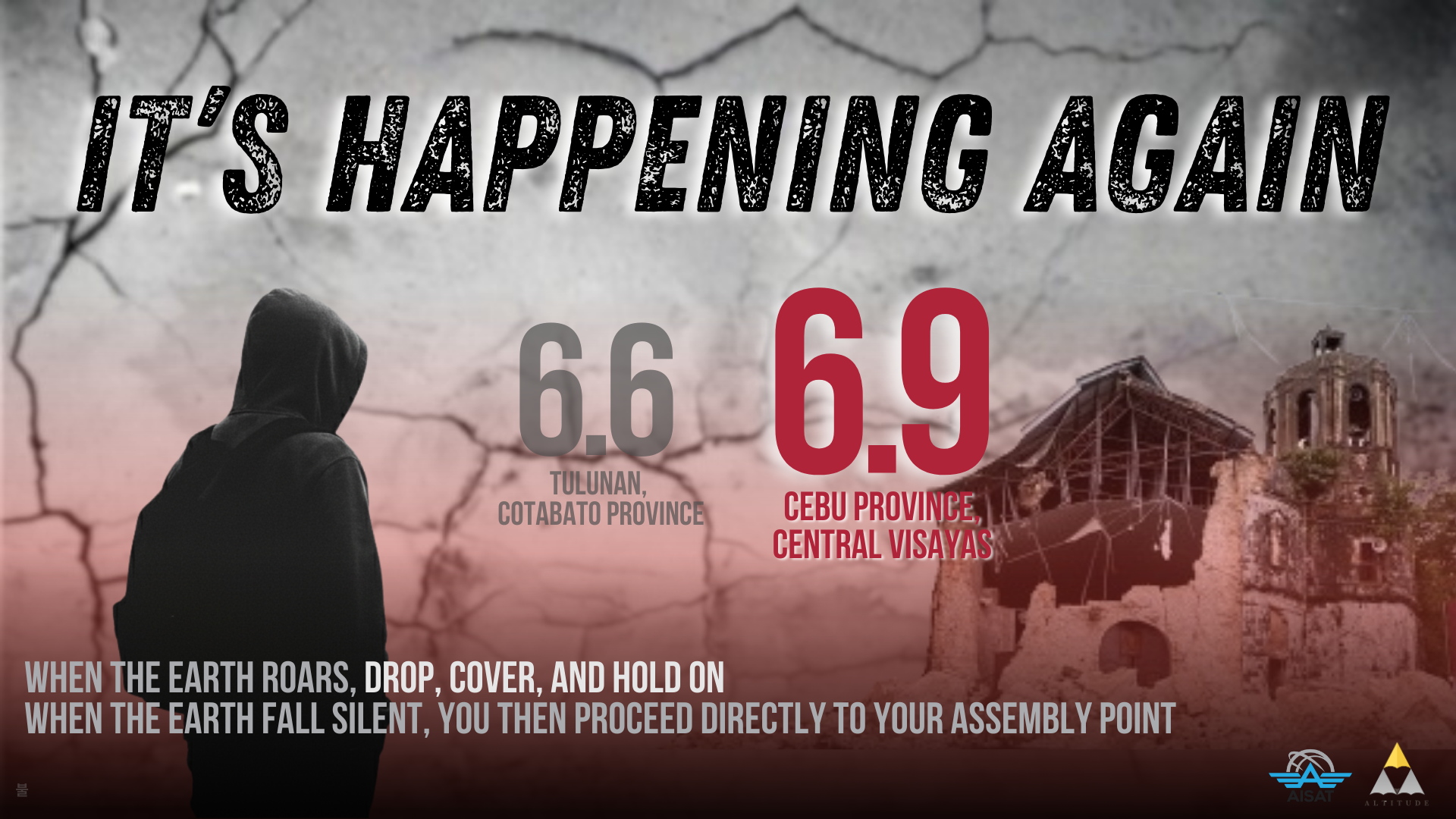
September jolted me awake, not with terror, but with a frantic, cold dread. The 6.9 magnitude earthquake was back.
This wasn’t my first time in the glare of these headlights. I had faced the 6.6 magnitude quake in Kidapawan City back in 2019.
But that hard-earned confidence was shattered instantly, lost in the desperate shouts for the people I live with.
In that chaotic moment, I felt the full weight of my older sister’s fear. The world became a cacophony of competing crashes—vases and family photos smashing on the floor, the frantic barking of our dogs, the yelps of neighbors. It was a chaotic soundscape my sister, a multimedia arts student, would never have expected to find for her cinematic SFX collection.
But this was no library sample. In an instant, everything digital and simulated felt obsolete, replaced by the devastating, perfect clarity of the real thing. And in the face of that clarity, I was frozen. I couldn’t react.
My sister was already pulling us out of the house. Her mind was a torrent of selfless adrenaline, thinking of her two younger sisters and our three dogs. Outside was relatively safer, she reasoned, in the comfort of our neighbors.
But the thought hung heavy in the air: we were in a residential area utterly lacking in community training for earthquake emergency responses and procedures. Our safety depended not on a plan, but on a frantic, loving instinct.
It is only now, in the stillness, that the terror truly sets in.
We shouldn’t have hastily gone outside. In that blind sprint, we were running through a gauntlet of endless possibilities: a shard from broken collections, a falling roof tile, tall furniture, the very debris of our own home.
My sister’s adrenaline-fueled rescue could have so easily been punctuated by the very injuries we were fleeing from.
Yet, I, too, repeated the same mistake.
That frantic flight was born from a fierce, protective love, but it was a gamble with our very lives, from which I now understand professionally. A lesson from that day, I would later learn not just as a survivor, but as an aviation safety engineer.
During my OJT, while analyzing emergency response procedures for aircraft incidents, a fundamental principle was drilled into me: panic is the enemy of procedure, and procedure is the shield against panic. The same rigid, life-or-death protocols that guide a flight crew through a decompression—where seconds count, and panic is fatal—apply with terrifying clarity to an earthquake.
My professional training has now reframed that moment of frozen fear, giving me a clear, actionable blueprint for what we should have done.
In aviation safety, we don’t trust instinct; we train for it. The global standard for earthquake safety is not “run,” but “Drop, Cover, and Hold On.” This is not a passive reaction—it is an active, deliberate procedure.
Drop to your hands and knees to prevent being knocked over. Cover your head and neck by getting under a sturdy table, creating a protective void. Hold on to that shelter, because the violent shaking can move it, and you, across the floor.
This protocol is engineered to protect you from the primary killers in an earthquake: falling ceilings, shattering glass, and flying objects—the very “gauntlet of possibilities” we ran through. My sister’s loving act of pulling us outside unknowingly placed us in the path of the greatest danger.
But the procedure doesn’t end when the shaking stops.
This is the second critical phase I learned as a safety engineer: the immediate evacuation to a pre-determined Assembly Point. Once the ground is still, the risks shift from the shaking itself to the compromised structure it leaves behind. The command “evacuate” is not a signal for a panicked sprint, but for a calm, swift, and directed movement to a pre-identified safe zone, away from buildings, power lines, and other hazards.
So, the corrected sequence, branded into my mind by both trauma and training, is this:
When the earth roars, you Drop, Cover, and Hold On.
When it falls silent, you then proceed directly to your Assembly Point.
The terror of that September evening is now fused with a professional purpose. Emergency response must be practiced until it becomes a new instinct. My family and friends did not have a plan, and so we fell back on a dangerous one.
Now, I have made it my mission to ensure that others can replace that frantic dread with a procedure that saves lives.