November 30, 2025
by Zeth Angelo Bacaoco
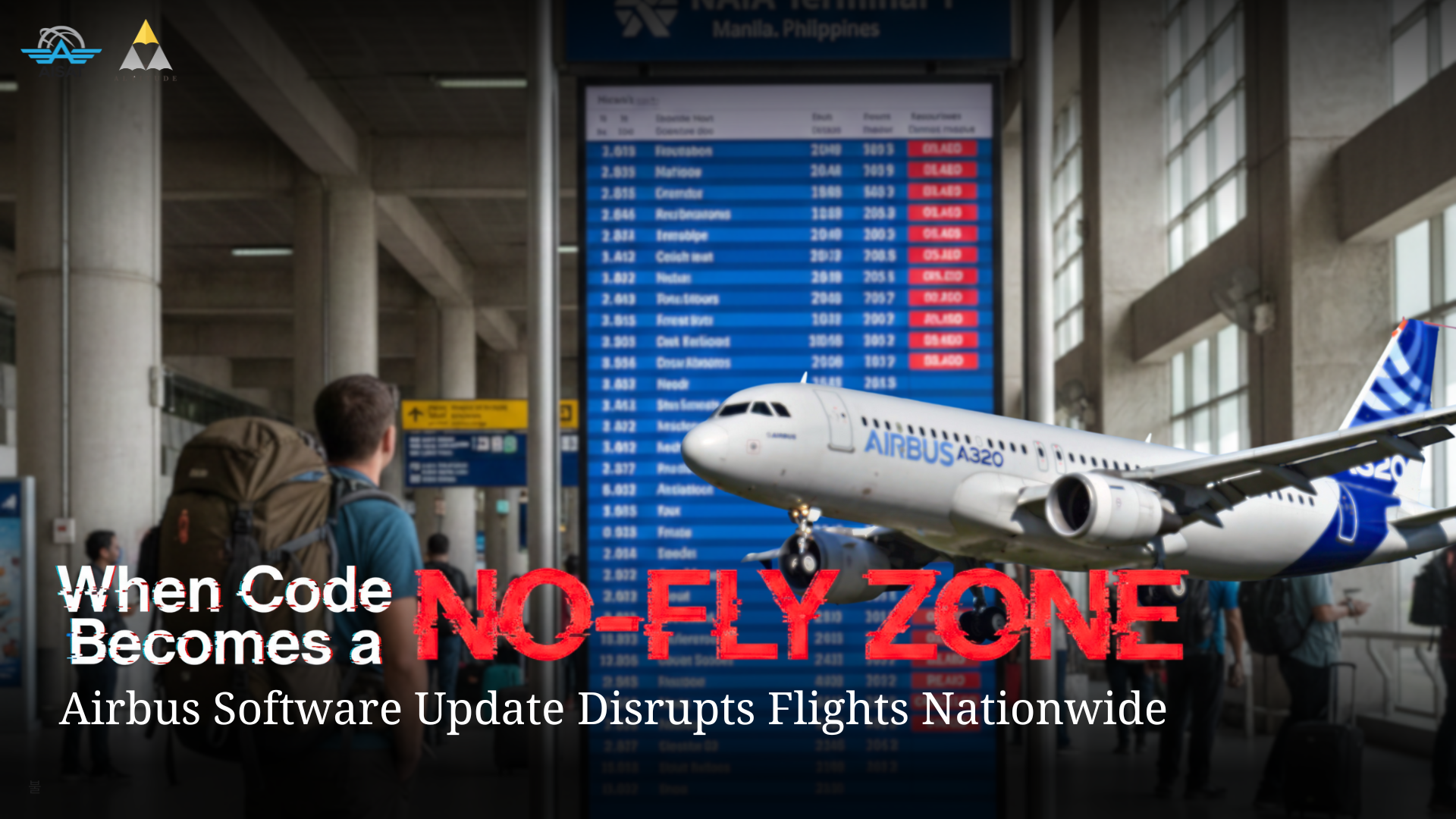
Local air travel across the Philippines was disrupted after Airbus transmitted a technical advisory to aviation authorities at around 1:00 a.m. on Saturday, November 29, requiring operators to immediately implement a software update or rollback on affected aircraft systems before further deployment. The advisory, later reinforced by an Airworthiness Directive issued by the European Union Aviation Safety Agency (EASA), affected Airbus A320 and A321 aircraft, resulting in widespread flight delays and cancellations nationwide.
Transportation Secretary Giovanni Lopez confirmed that the directive was part of a global safety action impacting approximately 6,000 aircraft worldwide. In the Philippines, 75 aircraft operated by Cebu Pacific, Philippine Airlines (PAL), and AirAsia Philippines were affected. The Department of Transportation (DOTr), together with the Civil Aviation Authority of the Philippines (CAAP) and the Civil Aeronautics Board (CAB), immediately coordinated with airline operators upon receipt of the advisory to ensure compliance.
“This is a global occurrence. Worldwide, an estimated 6,000 aircraft are affected. Locally, among Cebu Pacific, Philippine Airlines, and AirAsia, we have 75 aircraft that are affected,” Lopez said during a joint press briefing on Saturday. Each aircraft required approximately two hours to complete the mandatory software update, forcing airlines to ground planes and adjust flight schedules temporarily. Authorities said the decision to implement the update immediately was made despite the expected disruptions, stressing that passenger safety remained the top priority.
Cebu Pacific Chief of Corporate Affairs Michael Shau said that as of 10:30 a.m. on November 29, 22 aircraft still required updates. Out of the airline’s 45 aircraft, 19 had already been updated, resulting in the cancellation of 66 flights.
“We feel it will be completed by Sunday,” Shau said.
Philippine Airlines confirmed that 28 of its aircraft were affected. Salvador Britanico, PAL Vice President for Corporate Affairs, said the airline deployed technical teams as soon as the notice was received.
“We expect completion within the next 24 hours, most likely by lunch tomorrow,” Britanico said.
AirAsia Philippines said it had already complied with the required software rollback directive and had begun restoring its operations. The Air Carriers Association of the Philippines (ACAP) assured the public that all system upgrades would be completed by noon on Sunday, November 30. ACAP Executive Director Jose El Perez de Tagle said airlines were working continuously to minimize the impact on passengers.
“Given this software update, which was mandatory, we want to assure the public that airlines are doing their best to notify passengers and minimize the effect of the system upgrade,” de Tagle said.
President Ferdinand Marcos Jr. directed the DOTr and CAAP to ensure passenger safety and provide immediate assistance to travelers affected by the disruptions. Airlines offered rebooking options, refunds, and travel vouchers, while airport authorities provided food, drinks, and basic medical assistance to stranded passengers. Following the briefing, Lopez visited Ninoy Aquino International Airport (NAIA) Terminal 3 to personally assess passenger conditions.
Airbus acknowledged that the implementation of the software update could cause short-term operational disruptions but emphasized that the measure was necessary to maintain aircraft airworthiness. EASA also stressed that compliance with the directive was essential to ensure safe flight operations. Authorities said airline schedules were expected to gradually normalize by Sunday afternoon, November 30, once all affected aircraft were cleared for service.