
December 30, 2025
by James Leonard M. Bautista, AMT
At the end of each semester at the Asian International School of Aeronautics and Technology, the hallways get quieter, the grades are finalized, and the professional smiles last a little longer than usual. It tells the students that they are done and that they should take a break before the next academic climb. But behind the closed doors of faculty offices and rooms, a different story is happening.
It’s a story that people don’t often talk about.
It lives in the deep breaths you take after the last class, the quiet moments you have to think after the last submission, and the small thrill that starts even before the tiredness goes away. It’s the well-known finish line, where one academic race ends and another one waits to start.
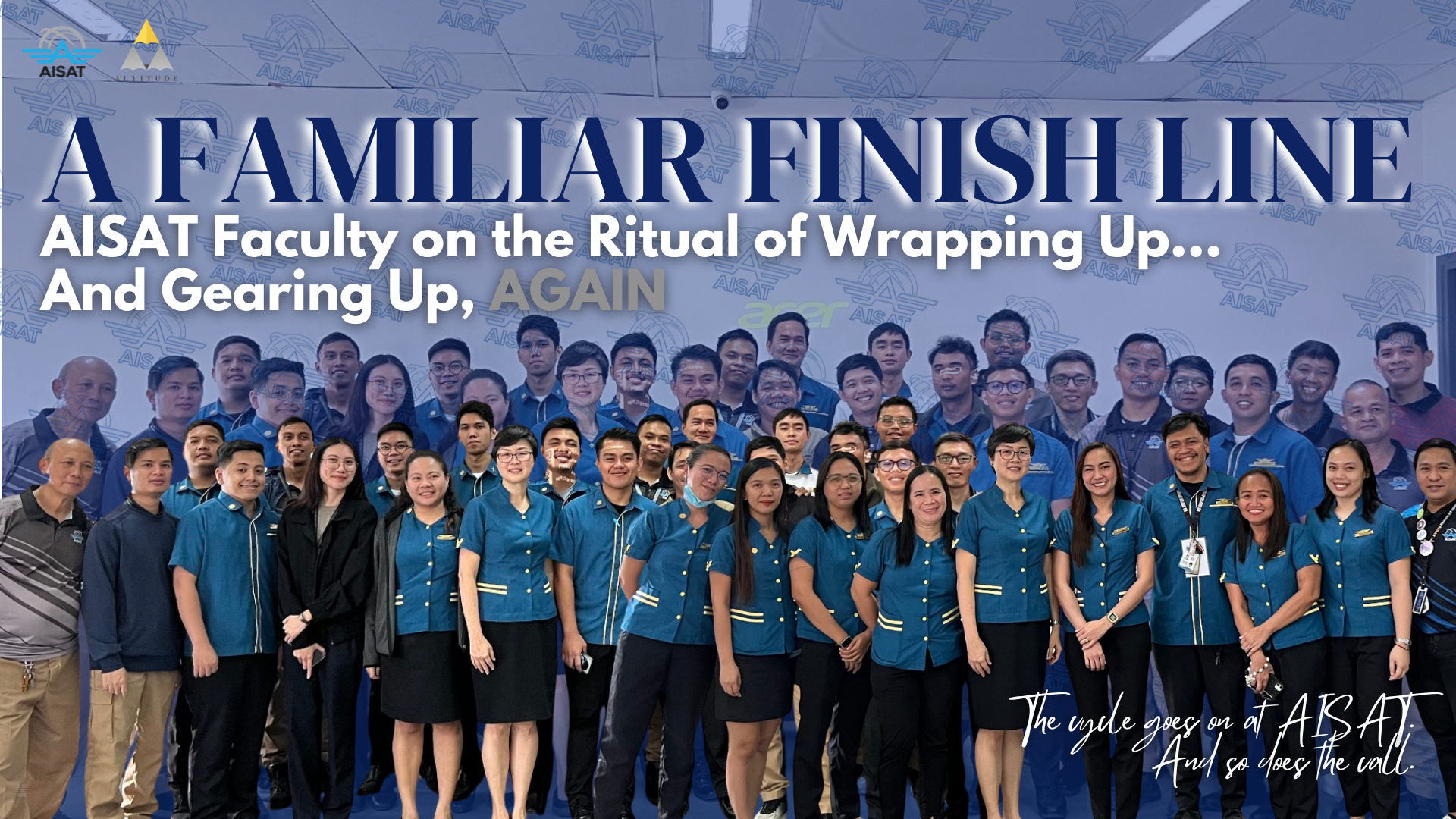
Seven AISAT teachers, from both general education and very technical aviation fields, were asked to put this shared but unspoken feeling into words. What came out was not just one feeling, but a strong group rhythm: relief and pride, tiredness and fulfillment, thinking and renewal—all at the same time in the heart of a teacher.
Sheila Mae D. Aparece, LPT
Subject: Rizal 1
As a teacher in Gen Ed, teaching is still a fulfilling vocation. This semester was very fun, interacting with students and, of course, working with beautiful characters in our department. I have learned a lot this semester. Hoping that in the coming semester, I will also learn a lot from teaching about the goodness of life!!! The people of AISAT is still the best for me!
For Ms. Aparece, the end of the semester is more than just the end; it’s a time to be thankful. Her words show that she loves teaching for more than just lesson plans and tests; she loves it for the people she meets. Her heart is still open to learning, growing, and the simple goodness that teaching brings, even though one chapter is over.
Aubrey Marie Cabonce, LPT
Subject: GE 4—Art Appreciation and GE 9—Great Books
It has been a cycle for me since I’ve been teaching for almost a decade. It’s been the same relief after ending another year of teaching, and another semester of one or more subjects. The anticipation has always been there for the much-awaited break because teaching is very exhausting, not just physically, but of course, mentally & emotionally. The excitement of a new subject for the new semester is also very exciting. I am always excited about meeting a new set of students and discovering how I can adjust to meet their level. Overall, teaching has always been fulfilling, most especially when you end another semester and realize how fast it went and how strong you’ve been.
Ms. Cabonce has been a teacher for almost ten years, and she captures what many teachers feel: teaching is like running a marathon over and over again, and each time it gets harder, but it’s always worth it. At the end, tiredness meets self-awareness. Survival turns into strength, and strength turns into purpose.
Eileen Kim C. Baluso, AMT
Subject: AVI 113
The shared sentiment at the end of the semester is a quiet sense of relief and fulfillment. After weeks of preparation, continuous study, and refining lectures to effectively deliver concepts to students, there is satisfaction in seeing the work come to completion. While there is a natural tiredness, it is balanced by a hopeful mindset focused on reflecting on what worked well, identifying areas for improvement, and preparing to do better in the next term. It truly marks both an ending and a renewed commitment to growth as an instructor.
Ms. Baluso’s reflection is calm, thoughtful, and very grounded. Her words show that she has a professional attitude when it comes to aviation training, where accuracy is important. She sees endings not as conclusions, but as points along the way to improvement. She made sure that the process of both learning and relearning is streamlined from her professional experiences in the field, yet grounded with a heart to convey relatable experiences.
Kurt Gabriel P. Cabinian, AMT
Gas Turbine Engine 2 and Propulsion I
The shared sentiment at the end of the semester is a quiet sense of relief and fulfillment. After weeks of preparation, continuous study, and refining lectures to effectively deliver concepts to students, there is satisfaction in seeing the work come to completion. While there is a natural tiredness, it is balanced by a hopeful mindset focused on reflecting on what worked well, identifying areas for improvement, and preparing to do better in the next term. It truly marks both an ending and a renewed commitment to growth as an instructor.
The end of the semester is very personal for Mr. Cabinian. He used to be a student and is now a coworker. He is at the crossroads of legacy and duty. His words talk about being a mentor, showing respect, and the strong cycle of learning that is a big part of AISAT’s academic culture.
Ham Riche Mirafuentes, AMT
AMT 212 and AVI 112
In the world of aviation, we are accustomed to the idea of flight as a journey – constantly moving but differs from one moment to another. as an aviation instructor myself, the unspoken sentiment for me is a blend of pride, humility, and nostalgia as one door closes and another one opens with full of promise and full of skies waiting to be explored. It is a shared experience and happiness watching our students fly solo, knowing they will take off into the world with the knowledge and tools we’ve helped them build and refine. And with that, I find my own quiet strength and hope, knowing that the lessons we imparted are part of something much larger than ourselves.
At AISAT, a few metaphors hit home as much as flight itself. Mr. Mirafuentes thinks that teaching is like flying: it requires discipline, is full of meaning, and can be emotional. At the end of the semester, it’s a quiet moment of awe to watch the students take off, knowing that the ground support will soon lead another crew.
Kim Deaño, AMS
AMT 311 & AET 212 – Electronics Fundamentals; AVI 113 – Aviation Maintenance Practices
Every semester ends with a quiet sigh of relief—having made it through another academic cycle. Faculty often find themselves asking each other how certain students did, especially when managing multiple sections filled with diverse personalities and learning needs. Teaching subjects that are challenging and not immediately visible or tangible to students requires patience, creativity, and constant reassurance of their relevance to future work. Beyond the classroom, some responsibilities continue behind closed doors—documentation, meetings, deadlines, and preparation for the coming term. While students may see teaching as the end of the day’s work, much of the time is spent refining lessons, updating materials, and ensuring readiness for the next semester. Despite the relief, what carries forward is a quiet anticipation—first for a well-earned break to rest and recharge, and then to improve, to teach more clearly, and to reach students more effectively the next time around. And as much as the work continues, faculty are reminded that caring for one’s well-being is essential because effective teaching begins with a healthy and grounded educator.
Ms. Deaño talks about the parts of teaching that people don’t see, like the hours that go by after class and the mental load that stays with teachers long after class ends. Her reflection reminds readers that balance and self-care are just as important as dedication when it comes to being a good teacher.
Vencent Gazmen, AMS
Subject: Electronics
Behind the professional smile and the finalized grade reports, the unspoken sentiment that many of us at AISAT share at the end of every semester is a quiet mix of relief, reflection, and renewed responsibility. There is relief because a demanding cycle has come to completion—weeks of lesson preparation, assessments, troubleshooting labsheets, and mentoring students through both technical challenges and personal doubts. In electronics fundamentals, where precision and safety are non-negotiable, that weight is felt deeply by us instructors. There is also reflection. We silently review what worked, what didn’t, and which students grew beyond what the grades can show. We think about the moments when a concept finally “clicked,” the late consultations, and the times we pushed students because we saw potential they hadn’t yet recognized in themselves. Most of all, there is a renewed sense of responsibility. As one door closes, another opens with a new set of students who will one day be responsible for aircraft electrical/electonics systems, lives, and trust. That realization grounds us. It reminds us that our role goes beyond delivering content. We are shaping discipline, judgment, and professional movements. So the unspoken sentiment is not exhaustion alone, nor pride alone, but a steady commitment: to carry forward the lessons of the past semester and to return, once again, ready to teach with purpose, humility, and care.
Mr. Gazmen’s words make the feeling more serious. Teaching, especially in technical fields, is more than just giving instructions; it is also being responsible for others. The end of the semester reminds us of a sad truth: what happens in the classroom today affects the weather tomorrow.
At the end of every semester, the AISAT faculty, who come from different fields and have years of experience, all agree on one thing: teaching never really ends. It stops. It thinks. It starts over.
The finish line is not marked by applause or ceremonies, but by quiet strength—by teachers who choose to come back even when they are worn out. Who gets ready to do their best again after every ending?
And when one door closes, another opens, full of new students, new problems, and skies that still need to be explored.
The cycle goes on at AISAT.
And so does the call.