August 15, 2025
by Mellisse Geisha Jamora
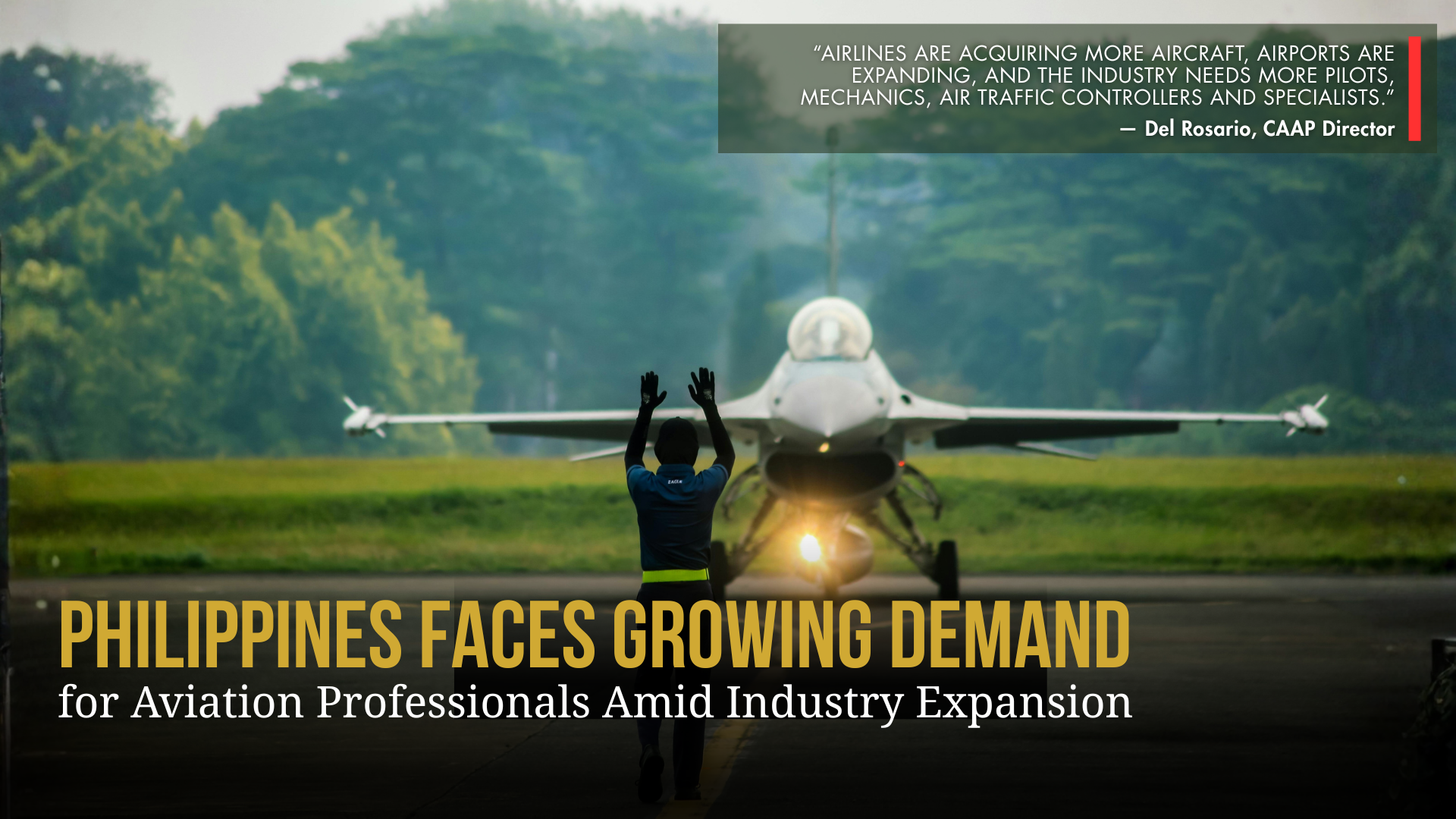
The Philippines’ aviation industry is currently in the predicament of the growing demand for trained aviation personnel as the industry continues to grow and operations continue to expand. As reported by the Civil Aviation Authority of the Philippines (CAAP), the air travel sector is currently expanding at a rapid rate, widening the gap between its capacity to produce trained personnel and meeting the workforce’s demand for pilots, aircraft mechanics, air traffic controllers, and other aviation specialists. CAAP Director General Lt. Gen. Raul Del Rosario highlighted that passenger volumes have already exceeded the system’s design capacity, leading to urgent calls for more trained professionals to aid and support both domestic and international operations.
“Airlines are acquiring more aircraft, airports are expanding, and the industry needs more pilots, mechanics, air traffic controllers, and specialists,” Del Rosario said at a recent aviation event.
CAAP’s solution to this is modernizing and investing in its Civil Aviation Training Center by acquiring new simulators and improving training facilities to further strengthen the system’s defense for the future growing demands and accelerate workforce development.
This surge in demand reflects global trends. Forecasts such as the Boeing 2020 Pilot and Technician Outlook estimate that the number of required commercial aviation workers in the coming decades will reach millions, including hundreds of thousands of pilots and aircraft maintenance technicians. Another perception of separate industry analytics firms also indicates that Asia will be a significant driver of aviation growth with its expanding fleet of airlines and rising passenger traffic, fueling the need for more trained professionals.
To battle the challenge of industry expansion, the Philippine government and industry stakeholders are taking steps to address these workforce challenges. In 2025, the Philippine State College of Aeronautics (PhilSCA) was converted into the National Aviation Academy of the Philippines (NAAP) through Republic Act No. 12255, officially designating it as the national institution for aviation training. The reform aims to enhance the quality of aviation education through fostering partnerships with government and private sectors, aligning training standards with global demands, and producing a skilled workforce capable of supporting both the sectors of commercial aviation and national defense.
On the other hand, Philippine Airlines also made its response against the growing demand by reopening the PAL Aviation School in partnership with Airways Aviation of Australia. This year, the airline sent its first batch of cadet pilots abroad for advanced flight training as part of its strategic initiative to produce competitive pilots in support of its fleet expansion plans, which include deliveries of new aircraft in the coming years.
Provincial initiatives are also emerging to support the aviation workforce development. During the 2025 Cebu Aviation Summit, a proposed scholarship program was announced with the purpose of providing opportunities for students to pursue careers in aircraft maintenance, engineering, and ground operations. Officials emphasized that strengthening aviation training and education is not only essential for aviation’s economy but also a viable career path for Filipino youth responding to global demand.
For students who aspire to be professionals in the field of aviation, this growing demand presents an opportunity for them to pursue their career goal, which can range from pilots and aircraft mechanics to air traffic controllers and aviation technicians, as aviation education and training are currently being prioritized by the industry. As it continues to recover from the pandemic, the industry also focuses on positioning the Philippines as a growing aviation hub in the Asia-Pacific region, pushing educational reforms and training partnerships, which will play key roles in reinforcing the next generation of aviation workers.